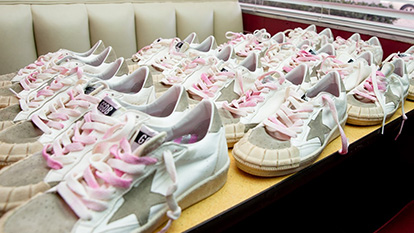
Ours is a story of innovation and research, respecting a tradition rooted in Italian craftmanship and in solid, long-lasting relationships built over time with our suppliers. We are committed to establishing supplier partnerships that are based not only on the level of technical and qualitative excellence and reliability of the products manufactured, but also (and above all) on shared social, ethical, and environmental values and principles.
HOW WE CRAFT

Over the years, we have strengthened our relationship of trust and collaboration with our suppliers, who stand out among small-sized enterprises and businesses. This continuity contributes to maintaining the high technical and quality performance of our products, while enabling the coherent and long-term planning for growth and development.
The production and packaging of our products involves more than 100 suppliers, consisting of raw material suppliers, garment manufacturers, and finished product suppliers.
Finished product suppliers are tasked with the realization of our footwear collections, a residual part of the ready-to-wear, and all the accessories. Garment manufacturers, involved in the realization of almost all our ready-to-wear collections, have the high technical know-how and skills required to create our finished products, using raw materials provided directly by Golden Goose.
The creation of long-lasting relationships, the kind that create progress and value for all, requires respect, transparency, and trustworthiness, which is how we have always done business since the beginning of our journey.
All our partners must adhere to our same standards of conduct and they are all required to respect and comply with the principles set in our Code of Ethics and Supplier Code of Conduct. Our vision has been translated into a Social Compliance Framework that takes inspiration from the most relevant international standards for responsible business conduct and allows us to share our values and principles with our suppliers, while fostering fairness, sustainability, and transparency across the supply chain.
Based on this Framework, in 2022, we planned and completed 62 on-site audits both on direct and indirect suppliers, assessing our suppliers’ ethical and environmental performance, identifing any critical situations, and supporting them in implementing the corrective measures required to continue their partnership with us.
We are committed to protecting internationally recognized human rights in all aspects of our business operations, including our dealings with employees, suppliers, and all other stakeholders connected to our business. As evidence of this commitment, we have joined the UN Global Compact, and our approach to human and labor rights is inspired by both the UN Universal Declaration of Human Rights and the UN Guiding Principles on Business and Human Rights.
We have adopted several prevention and mitigation measures to protect human rights along the value chain, and outlined our commitment in a set of corporate documents and policies. In 2022, in addition to our existing Code of Ethics and Inclusion & Belonging Act, we worked with a specialized external firm to define our first Human Rights Policy, underscoring our commitment to respecting the human and labor rights of all our employees and contract workers in all countries of employment.
The raw materials mostly used in our collections are synthetics (about 63%) and natural fibers (about 29%), with a residual amount of paper and cardboard, cellulose fibers, and metals. We strongly believe that our first responsability is to know everything about our raw materials, their origin and processing at every stage of their life cycle. Full visibility over the entire supply chain ensures its timely monitoring, and favors the research and development of alternative materials that allow us to improve our standards of quality and sustainability.
We started with the traceability of leather, tracing 100% of the amount required for our ready-to-wear collections and more than 90% of the total amount required to create our sneaker collections (100% of which comes from Italian tanneries). The analysis revealed that the sleatherhouse traced are located primarily in South Africa and in Europe and none are in countries at risk of deforestation. The analysis also revealed that 79% of our leather is sourced from both gold and silver LWG-certified suppliers.
During the year, we further expanded our traceability analysis so as to include cotton, predominantly used in the making of our readyto- wear collections. We gained useful information on about 95% of the cotton used in 2022 and mapped 90% of the spinning mills involved. The overall cotton used in our products came mainly from Türkiye (71%). Meanwhile, the spinning suppliers from whom we source our cotton-based fabrics are mainly in Italy and almost all of them are GOTS-certified.
Quality and safety are priorities right from the design phase of our garments and the purchase of raw materials. We work closely with our suppliers to ensure that each product is in line with the desired specifications and with our Raw Material and Finished Product Performance Requirements Manual of reference.
Our Product Compliance Department monitors the presence of chemicals in our raw materials and finished products by maintaining a Product Restricted Substances List (PRSL), which includes 22 groups of substances covering over 380 prohibited or limited substances. It also includes two sets of product safety requirements, based on customer age range (children or adults), ensuring compliance with the most stringent national and international provisions.
GOLDEN STORIES